Frequently asked questions
How our mats are made, what to send us for a logo, and how orders are quoted, shipped and cared for. The twelve questions we answer most often.

Ordering and artwork
What to send, how proofs work, and how custom work gets scheduled.
How long does a custom logo mat take?
Custom work runs in two stages: a digital proof you approve, then production. Proofs normally come back within one to two business days, and production is scheduled from approval. Tell us your install date and we will confirm the lead time in writing before the order starts.
What artwork should I send for a logo mat?
Vector files are best: AI, EPS or PDF with text converted to outlines. A high-resolution PNG or JPG at 300 dpi works for simpler marks. Please do not send a photo of a business card or a screenshot, because neither can be cleaned up at mat scale. We always proof the artwork before anything is cut.
Can you make custom sizes and shapes?
Yes. Most of the range can be made to measure, and printed mats can be cut to circles, ovals and half rounds. Sizes are rounded to the nearest whole foot and can vary a few percent in production, so check the finished dimensions against your matwell or doorway before you order.
Will the logo colors match my brand, and will they fade?
We match to your brand colors and approve a proof before production. Printed logo mats hold color best indoors or under a covered entrance, because long exposure to direct sun is what fades print over time. If the mat will sit in full weather, say so and we will steer you to a better construction.

Choosing a mat
Cushion, grip, drainage and clearance, matched to the floor and the traffic.
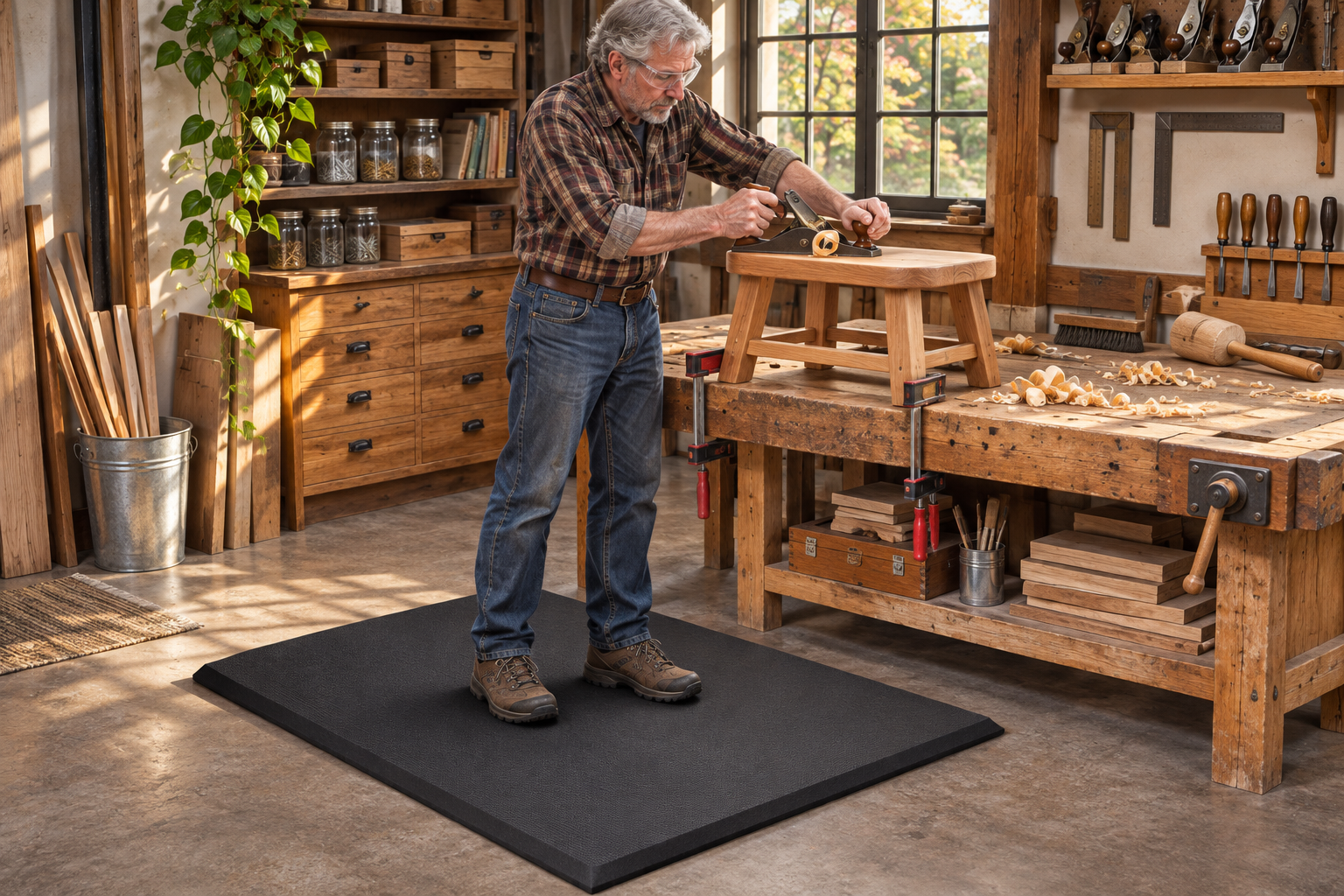
Which mat is best for people who stand all day?
Anti-fatigue lines such as Supreme Ergo Flooring, Enviro Tred and Safety Step Mats are built for long shifts: they cushion the stance and use a beveled edge to reduce trip points. Vinyl and printed logo mats are firmer surfaces, better suited to branding and lighter foot traffic.
Which mat handles snow, slush and wet weather?
Use two mats. Outside, a rubber flow-through scraper lets heavy slush fall through before it reaches the door. Inside, an absorbent entrance mat wipes and traps what is left. One mat alone cannot do both jobs, which is why entries that get real weather usually run a pair.
My mat slides and creeps along the floor. How do I stop it?
Choose a gripper backing on hard floors. It adds surface area underneath, so the mat grips instead of walking. On carpet, use an underlayment suited to the pile. This is also the single most effective fix for mats that ruck up at the door.
Will the mat be a trip hazard, or stop my door from opening?
Low-profile mats with beveled or rubber borders are designed to avoid both. To check door clearance, stack a used deck of cards about six inches from the door, close the door slowly and let it push the cards aside, then measure the stack that is left. That is the thickness you have to work with.
Materials and care
Backings, chemicals, cleaning and where each mat belongs.
What is the difference between rubber and PVC backing?
Rubber is the more durable backing, it is heavier, lies flatter and can be machine washed. PVC is the cost-effective option and can be steam cleaned. Both work; the choice comes down to traffic, cleaning method and budget.
Will the mat handle oils, grease and chemicals?
For kitchens and plant floors, a rubber drainage mat lifts feet off the wet surface and lets grease and water fall through. Resistance depends on the specific chemical, so send us the product data sheet or the fluid involved and, for aggressive chemicals, request a sample to test before you commit.
How do I clean and store the mats?
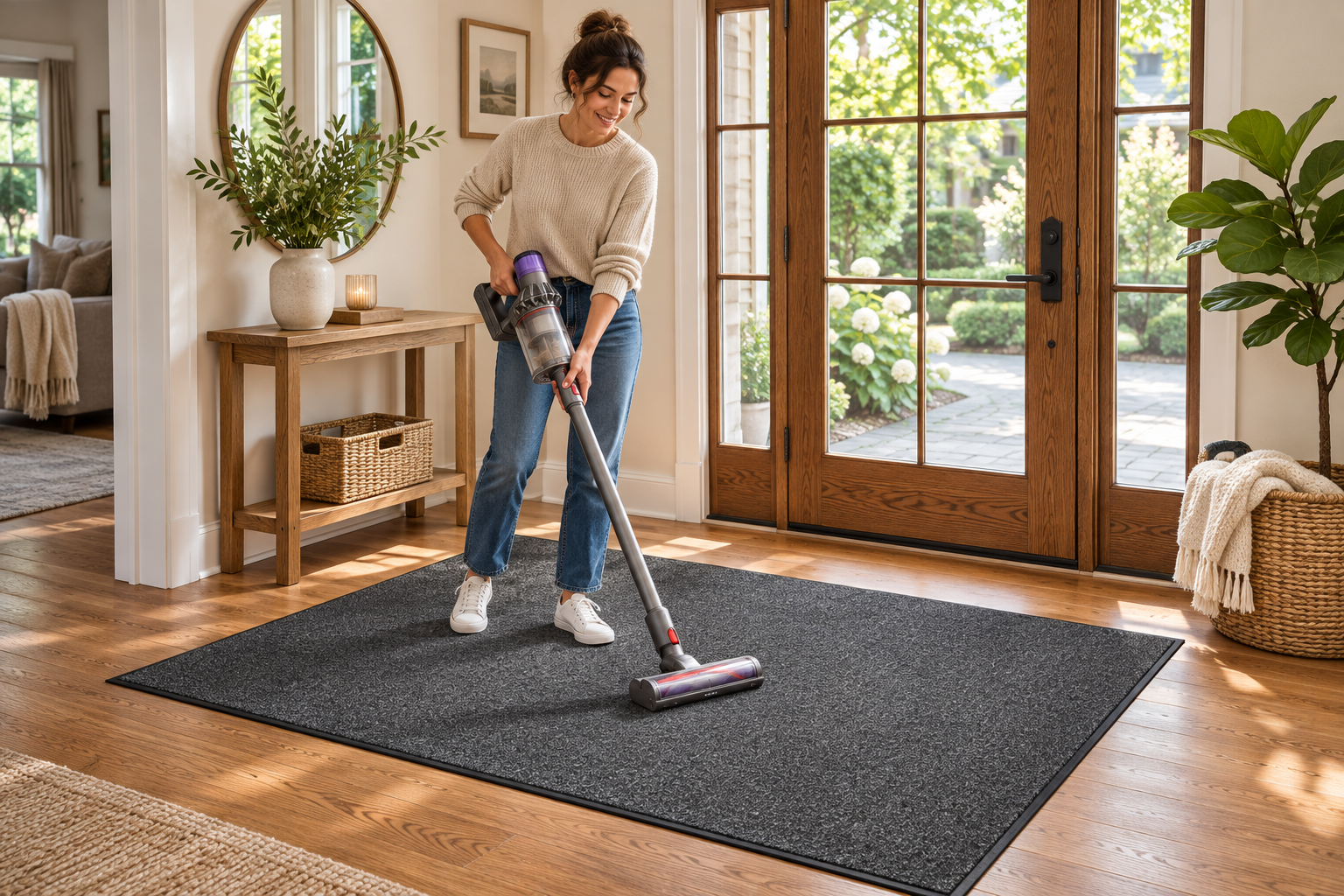
Vacuum or shake out grit regularly, wash with mild soap and water, and dry flat on both sides. Skip bleach and solvents on printed surfaces. Roll mats for storage rather than folding, so the backing does not crease.
Can mats be used outdoors, and will they go moldy?
Outdoor scraper and flow-through mats are made for it, and our synthetic turf lines suit patios, rooftops and sports surfaces. Mold comes from moisture trapped under a mat, so lift and dry absorbent mats after soaking, and choose an open construction where water cannot pool.